
Midlife Therapy: When Success Stops Feeling Like Enough

You did everything right. So why does something feel missing?
Why Priorities Change in the Second Half of Life
Have you ever caught yourself asking,“Why doesn’t any of this feel meaningful anymore?”
As a trauma-informed depth therapist working with midlife adults across the greater Seattle area, I hear this a lot. As you transition into your 40s or 50s, the drive that once fueled achievement, productivity, and identity begins to change.
This is not a crisis. At least, it doesn’t have to become one. As unsettling as it can feel, these moments of questioning are often a natural reorganization of unconscious motivation.
The word ego tends to get a bad reputation, often equated with arrogance or selfishness. In midlife depth therapy, ego refers to the organizing center of your conscious personality. Earlier in life, the ego works hard to establish stability and function. It forms a core identity, strives for financial independence, reaches toward external accomplishments, and builds secure relationships.
In midlife, however, the ego needs to soften in order to allow the less conscious parts of the personality to share the spotlight. Only then can we reclaim access to new meaning, revitalized creativity, and spiritual restoration.
What Midlife Restlessness May Be Telling You
If you find yourself unable to slow down and open to this inner process of inquiry, your psyche may begin sending signals that get labeled a midlife crisis.
Restlessness. Irritability. Emotional withdrawal. A sense that something essential has gone missing. These are not signs of failure. They are invitations to recalibrate before the cost of ignoring them becomes too high.
I’m Brianna Clement, a Licensed Mental Health Counselor in Bellingham, Washington specializing in traumatic loss and shame recovery during midlife.
Unconscious Complexes: Why Shame Takes Over
As a therapist, I often hear clients shaming themselves for all the different ways they are not doing something correctly. What stands out most to me is not the behavior itself, but the attitude toward it.
They are shaming the behavior they are already ashamed of. The inner attack simultaneously repulses and possesses them, pulling them into a self-sabotaging spiral. This is often the first sign that someone is held in the grip of a complex.
A complex is an unconscious, emotionally charged cluster of memories, ideas, and feelings rooted in past experience. When activated, it can temporarily overtake ego consciousness.
In those moments, we do not just feel something difficult, we become organized around it. Our view of ourselves narrows and our response to the surrounding world becomes rigid.
How Complexes Override Conscious Choice
You might think of a complex as an area of life where you reliably struggle, where your emotional reaction feels disproportionate and patterned. For example, I have a school complex that carries a fear of failure and learned helplessness. When I am presented with any kind of “test” as an adult, it is surprisingly easy for my inner five-year-old to take over. She appears in the form of mental shutdown, bodily numbness, and disconnection from the present.
The emotions my five-year-old self experienced were so overwhelming that they were splintered off from my conscious awareness through the superpower of dissociation. But like all dissociated parts of the personality, they don't disappear.
They are compartmentalized into the unconscious and reappear when activated. If we circle back to the theme of internalized shame I witness so often, it becomes clearer how uncomfortable complexes are and how urgently the ego tries to regain control.
Sometimes even on a good day, willpower is not enough to override what is being avoided. We may find ourselves pulled toward a compensatory distraction or compulsion.
Mindless eating. Scrolling without intention. Drifting into fantasy.
Eventually we catch ourselves, put the phone down, and double down on what needs to get done.
The Hidden Tension Driving Midlife Anxiety and Indecision
This has nothing to do with willpower. It has to do with your ego's inability to relinquish its agenda, and more importantly, its complete disinterest in what the rest of your inner life might be trying to tell you.
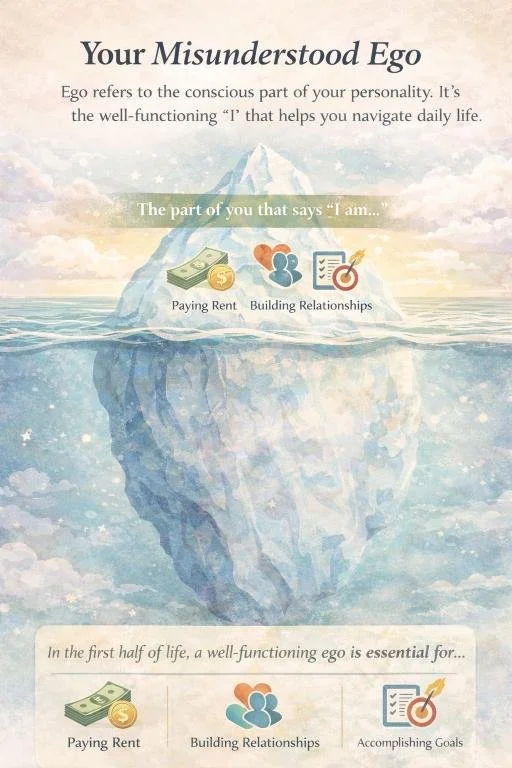
First, a brief clarification of a commonly misconstrued word.
When someone says "oh, he has such an ego," they're describing an ego inflation. The ego itself simply refers to the conscious part of the personality.
During the first half of life, developing a sturdy ego is essential. It helps us decide what relationships we want to invest in, how we want to spend our time, and what kind of life we want to build.
Ego gets a bad reputation it doesn't entirely deserve (no wonder it has an inferiority complex).
On the other hand, the ego is also not interested in your desires, your passions, or whatever your intuition might be quietly calling you toward.
Ego vs. Unconscious: Navigating Inner Conflict
Carl Jung (the founder of depth psychology) states there is often an existing tension between our conscious attitude and our unconscious wisdom (Jung, 1933). This neurotic split can become so unbearable that we collapse into doubt and indecision, or we make premature decisions guided by unknown fear, weakness, shame, or grandiosity.
Reclaiming the Self Beneath Longstanding Roles

Productivity, rational decision making, accumulation, and achievement are richly rewarded in the modern world, and the ego fits right in.
Think of your personality as an iceberg. The ego, the "I" you move through the world with, sits just above the surface. Underneath, submerged and mostly out of view, is everything else in the unconscious.
It genuinely feels good to check something off a list, and I am not here to place any judgment on it. At the same time, there is an inner “other” that has its own list guided by a completely different set of values. Values that ask what you are ultimately in service to, what gives your life meaning, and who you are beneath the roles you’ve been playing (Hollis, 2006).
Midlife as Psychological Awakening
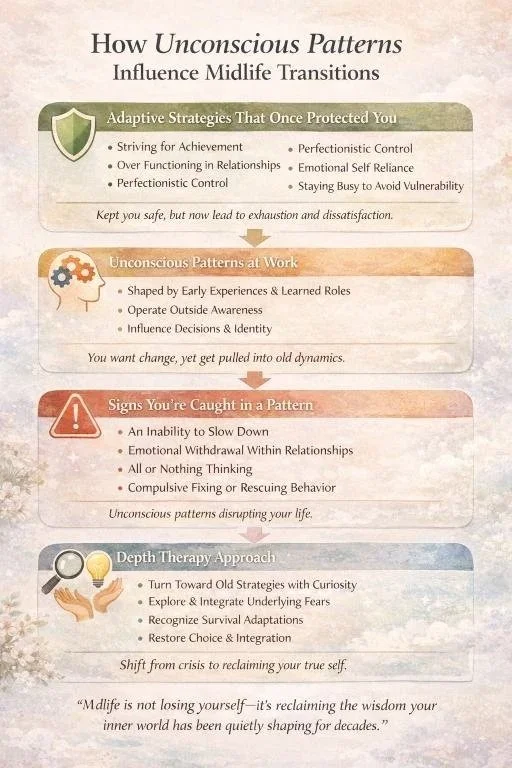
Midlife is more than a series of external changes. It is a psychological shift that exposes patterns operating beneath conscious awareness. Before your 40s or 50s, you may have developed adaptive strategies that helped you survive earlier chapters of life.
Striving for achievement.
Self sacrificing in relationships.
Perfectionistic control.
This automatic conditioning once protected you from facing more vulnerable aspects of yourself in order to fulfill the goals you sought to accomplish. In midlife, these strategies become the source of exhaustion, relational strain, and insidious dissatisfaction.
These patterns are shaped by early experiences, cultural expectations, and the roles you learned to inhabit in order to belong. They operate outside awareness, yet influence decisions, relationships, and perception. You may want to change while feeling pulled back into familiar dynamics that no longer fit who you are becoming.
These patterns reveal themselves in subtle but powerful ways:
• 🧠 Your nervous system reacts before your rational mind can explain what is happening. (Anxiety, shutdown, irritation, urgency)
• 🔁 You repeat the same relational dynamics even when you understand them intellectually. (Over-performing, emotional withdrawal, people pleasing)
• 🌫️ You feel a persistent sense that something is missing, yet you cannot name it. (Restlessness, dissatisfaction, loss of meaning)
• 🏆➡️❓ Success or stability no longer brings the meaning it once did. (Achievement without fulfillment, productivity without purpose)
From Overperforming to Integration
Instead of overriding or suppressing old strategies, we turn toward them with curiosity. We ask what they protected, what they feared, and what they still believe is necessary for survival.
When unconscious material becomes conscious, its grip loosens. What felt automatic becomes understandable. What felt like a character flaw is recognized as a survival adaptation. In that recognition, choice returns.
Now offering extended therapy sessions for Seattle residents
What Depth Therapy Actually Does
In the mental health field, depth psychology is known for its central relationship with the soul. Soul work is not some pastel daydream achieved through an enlightened state of being (this would, in fact, be an ego inflation). It's about taking responsibility to turn toward what we would prefer to avoid and grounding that wisdom in our daily reality through dedicated action.
You Are Personal and Collective
Depth psychology understands that the individual cannot be separated from the collective. The collective includes what you inherited structurally, such as the systems you exist within, and genetically, such as your ancestral lineages.
We contextualize what brought you here in order to understand how to move forward. This is important information that helps you parse out what is personal and what isn't.
In my therapy office, I frequently witness how the ego tends to personalize issues that likely have nothing to do with my clients. For example, when you go to get your hair cut and notice your hairdresser isn't making the usual small talk, what’s your immediate reaction? It's common to wonder if you did something to make them upset, even when you know it’s unlikely.
From Shame to Responsibility
This tendency can be one of the culprits behind our defensiveness toward taking responsibility. When we can acknowledge that a system is set up for many of us to fail, it’s no longer accepted as a personal failure.
We become more willing to accept our situation for what it is and we become more empowered to change it.
How Jungian Depth Therapy is Different
Rather than managing symptoms from the top down, depth therapy engages the whole personality, including the parts that live below the surface.
Emotional Alchemy
A common misconception is that depth therapies are only concerned with insight and not behavioral change. In reality, research indicates that effective therapy across modalities shares common factors of successful treatment—including increased insight, empathy, psychological flexibility, and adaptive behavior.
The more useful question is: at what point does change occur? Psychoanalytic therapies, including Jungian depth psychology, propose that if you could think your way out of your own suffering, you would have by now. True healing occurs at an emotional level through the body, and within the safety of relationship.
The real issue is when the past is not truly in the past, when it shapes your present experience and limits your future without your awareness.
Your Inner Call to Reinvention

Licensed Mental Health Counselor Serving Seattle & Beyond
Emotional wounds, unresolved grief, and complex trauma can become initiatory experiences. Rather than collapsing into shame or withdrawing into isolation, midlife invites psychological growth. It asks you to outgrow the version of yourself you thought you had to be in order to embody the person you’re meant to become.
Psychological adulthood requires the accountability to recognize and change these long-standing patterns. Insight alone is not enough without endurance and action (Jung, 1945). Without intentional practice, new awareness fades and the nervous system defaults to habitual ways of seeing and acting.
Reflection, meditation, mindful movement, dreamwork, and somatic awareness help translate insight into change that lasts. This is how novelty promotes inspiration and how meeting you ‘inner other’ fuels momentum. Like building any meaningful relationship, this collaboration requires both openness and engagement.
Take the First Step Toward Midlife Transformation
You don’t have to stay stuck in the feedback loops of your past, living according to what the world once demanded of you. Those roles have been fulfilled.
The next question is: what is the task your life is asking of you now?
If you are a midlife professional in Washington or the greater Bellingham area feeling lost, disconnected, or unfulfilled, integrative depth therapy can help you reconnect with yourself and your relationships. By releasing old habits that no longer serve you, you rediscover your most authentic self and create space for meaning, self-trust, and relational intimacy.
Whether we meet online anywhere in Washington or in person at my Bellingham office, (1.5 hours from Seattle) you’ll find a supportive, nonjudgmental space to explore who you are beneath the roles you’ve been performing.
You don’t have to remain caught in cycles that leave you overwhelmed or disconnected. If you’re ready to reclaim your purpose, strengthen self-trust, and deepen connection with others, reach out for more information about pricing and scheduling.

The Life You Long For Is Already Waiting, Complete a Contact Form Today
Citations
Hollis, J. (2005). Finding meaning in the second half of life: How to finally, Really grow up. Avery.
Jung, C. G. (1945). Letter to Olga Froebe-Kapteyn, Letters I, 375.
Jung, C. G. (1933). Modern man in search of a soul (W. S. Dell & C. F. Baynes, Trans.). Harcourt, Brace.
These ideas inform the way I approach integrative depth therapy — not as symptom management, but as an invitation into deeper relationship with our wisest Self.

Brianna Clement is a Licensed Mental Health Counselor and Certified Kripalu Yoga Instructor based in Bellingham and online throughout Washington. She integrates Somatic EMDR, Yoga-Based Therapy, and Ketamine Assisted Psychotherapy for holistic healing. Brianna’s approach is trauma-informed and depth oriented to help midlife professionals rebuild relational intimacy and discover their inner calling after traumatic loss. At Intra Psychotherapy & Embodiment, she is committed to integrating psychoanalytic wisdom with modern, research-backed methods to create meaningful change at the emotional core.
