
A Therapist's Take on Reclaiming Your Inner Authority

Anger Isn't Always a Shield
Sometimes it's the honest voice you've learned to silence.
I'm Brianna Clement, Licensed Mental Health Counselor and Somatic Psychotherapist in Bellingham, Washington and online across the greater Seattle area. I help ambitious leaders move beyond family secrets and complex PTSD so they can create the connected, meaningful life they deeply desire.
If you've built a life around overextending yourself—putting your needs, wants, and desires aside to keep the peace—this post is for you.
When you're conditioned to over-function early in life, that pattern doesn't disappear. It follows you into adulthood, reenacting itself as chronic self-sacrifice in your relationships, your leadership, and your career.
From the outside, it often looks admirable. You're the reliable one. The dependable colleague. The person everyone knows will step in and make it work.
But if you're living in a constant state of fix-it mode, you run the risk of driving yourself into emotional dependency, cynicism, resentment, helplessness, and hopelessness.
When Over-Functioning Becomes a Way of Life
Being an empowered leader, a steady friend, or a secure partner doesn't require relentless overextension. It requires a regulated nervous system and discernment. Knowing when to tap your energetic resources, and when to preserve them.
These moments are invitations to reawaken an inner authority that has gone dormant. The part of you that knows how to say, "No." The part that recognizes when enough is enough. The part that wants to speak, but shuts up instead.
Why Survival Strategies Follow You Into Adulthood
These self-protective ways of functioning originate from a time when you genuinely had less power. When you were younger, they were adaptive. They helped you survive environments where pleasing, fixing, caretaking, or disappearing sheltered you from an unpredictable (perhaps even abusive) world.
But the strategies that once protected you need to change, before they keep pulling you into unconscious, regressive patterns.
Turning Maladaptive Fear Into Adaptive Anger
Healing requires transforming maladaptive fear into adaptive anger.
Not the kind of anger that looks for a fight.
Not road rage.
Not resentment that's been simmering under the surface.
I'm talking about your ferocity. Your life force.
The part of you that's empowered to protect what matters.

Healthy Anger Is Different From Aggression
Our culture often casts anger as something dangerous or destructive because it's frequently confused with aggression or rage. But healthy anger is motivating, life-giving and clarifying.
More often than not, I find an untapped relationship with anger beneath the surface-level symptoms that leave my clients feeling disconnected from themselves.
Anger points us toward the places where our boundaries have been crossed, our values compromised, or our needs abandoned.
When we learn to experience anger as information instead of something to fear, it becomes a guide back into alignment.
Anger doesn't disconnect us from others, it reconnects us to ourselves.
Emotion Isn’t the Enemy
Emotion is one of the most debated concepts in psychology. There are competing theories about what emotions are, where they come from, and what purpose they serve.
The way I understand them is this: emotions are complex reaction patterns involving physiological, experiential, and behavioral processes. We may experience them as irrational because they live in our bodies, often before our rational minds have caught up.
How Emotions Help Us Survive and Adapt
At their core, emotions are designed to help us survive and mobilize us into action (Greenberg, 2021). Fear prepares us to escape danger, anger energizes us to respond to violations, and sadness draws our attention to loss.
Emotions also communicate our needs, both to ourselves and to others. We lean in when we long for closeness. We pull away when we need space.
Before we can explain what is happening, our bodies have often already begun responding.
Begin in the Body
Emotion is embodied. It emerges before conscious thought.
Primary adaptive emotions—such as sadness in response to loss, anger in response to injustice, or fear in response to threat—are our immediate, instinctive reactions to the world.
Why We Learn to Disconnect
Increasingly, I believe that much of our suffering stems from our disconnection from this internal guidance system.
We have learned to distrust our bodies, override our feelings, and privilege analysis over direct experience.
In my therapy sessions, much of the work is helping people turn back toward their inner world. To notice what is already there and to trust those signals before trying to explain them.
This can be surprisingly difficult.
Our culture rewards productivity far more than presence. Many of us have been conditioned to keep moving, solving, producing, and optimizing.
Feeling, by contrast, asks something very different.
It asks for attention and connection.
It asks us to stay with an experience long enough for it to reveal its meaning.
Nervous System Regulation and Emotional Awareness
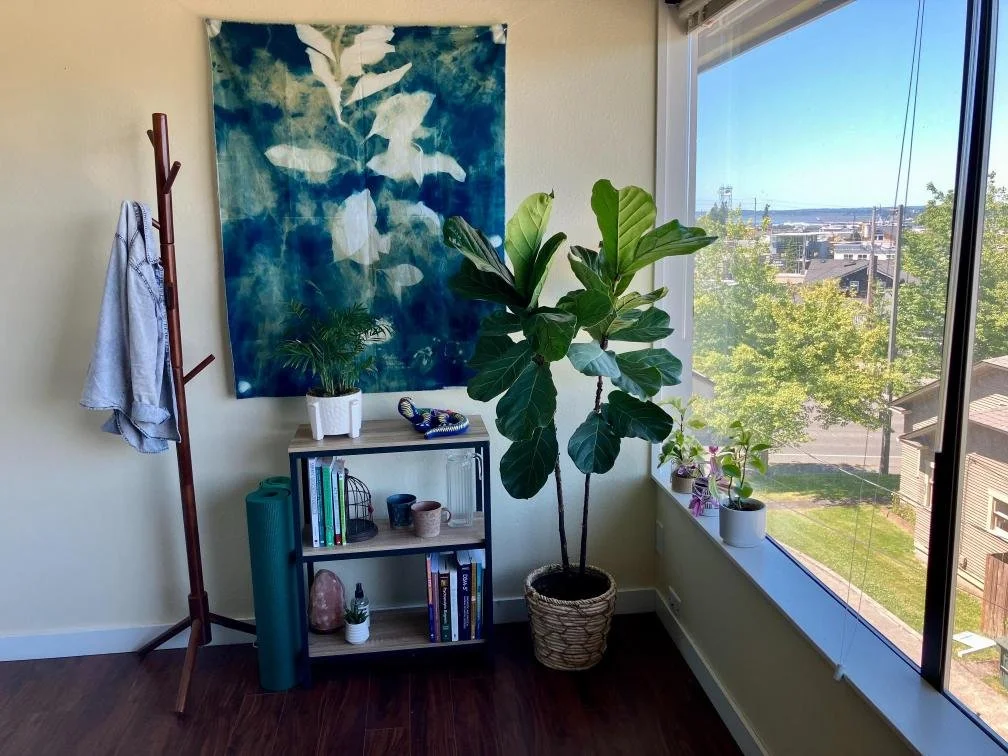
For many people, reconnecting with emotion begins by helping the nervous system settle enough to notice what is happening inside. This can mean gently redirecting attention away from constant planning, multitasking, and doing, and back toward present-moment experience.
If your inner world feels overwhelming or overstimulating, begin by resourcing yourself with an image in your environment. Rather than turning immediately inward, allow something outside of you to help create a sense of steadiness and orientation.
As a trauma-informed somatic psychotherapist, I use practices that support the nervous system in staying present with sensation. These experiential practices also draw on the right brain’s capacity for visual imagery and for processing emotional tone in communication.
A Practice for Resourcing
One of my favorite practices for weaving together felt sensation and symbolic imagery comes from Marian Dunlea’s work. BodyDreaming invites you to move between the sensations in your body and an image in your environment, allowing each to support and deepen your attention and presence.
Slowing down and staying with the image are the crucial components I find missing from other resourcing practices. Here is the gist of how I guide it for clients in session with some unique additions borrowed from my experience as a Kripalu yoga teacher:
Feel your feet. Plant your feet firmly on the ground and allow that groundedness to gently push you up and away from the floor.
Lengthen your spine. Allow this sense of rootedness to travel all the way up your spine. Imagine there is a string attached to the crown of your head, gently drawing you toward the ceiling.
Soften into gravity. On your next exhale, settle into gravity. Soften your shoulders and the muscles around your eyes.
Release unnecessary holding. Notice and release any tension you may be carrying in your hips. Allow your diaphragm to support your breath.
Find an image. Let your eyes slowly walk around the room. Allow them to settle on one image that naturally draws your attention.
Stay with the image. Give yourself time to simply notice it and no matter how mundane it may seem, become fascinated by it.
Return to your body. Notice whether tension has gathered again in your body. If so, gently return to the sense of a long spine and the support of the soles of your feet.
Let the image come forward. Return your attention to the image, allowing the surrounding space to fade into the background. Let your attention settle and soften with the image.
Exploring the Image
Once you feel settled with the image, become curious about what you notice.
What do you notice about the image? What is its shape like? Is it linear, or curved and flowing?
Is it jagged and fractured, or clean and soft?
Is it random and organic, or circular and repeating?
What does this image remind you of?
Notice how the image is residing inside of you. What happens in your body as you stay with it? Are you breathing more deeply or more shallowly? Is your mind speeding up or slowing down? Does your attention feel more narrow, or more open and expansive?
There is no right or wrong answer to these questions. The invitation is simply to notice. By moving gently between the image, your body, and the present moment, you may begin to discover an inner experience that becomes easier to feel, name, and stay with.
Return to Sensation
Before we can name an emotion, we usually sense it.
🫢 Tightness in the throat
🫀 Heaviness in the chest
💪 Tension across the shoulders
🌀 A knot in the stomach
🔥 Warmth
🫥 Numbness
🪨 Pressure
⚡ Restlessness
Sensations guide us into our emotional landscape. Learning to notice them is one of the first ways we begin rebuilding trust with ourselves.
Maladaptive Emotions
Core maladaptive feelings are tied to a painful view of self: the weak-me, who feels fragile and insecure; the bad-me, who feels worthless or like a failure; and the sad-me, who feels abandoned.
Maladaptive emotions originate from early wounds that shaped a negative relationship with the self. Over time, they can become a harsh internal voice, hiding from others, tiptoeing around ourselves, or maintaining a cynical view of the world.
Adaptive Emotions
Adaptive emotions include empowering anger, self-compassion, and the sadness of grief. Healing requires transforming maladaptive emotions rooted in the past through adaptive emotional expression in the present.
The key is simple: feelings must be felt, and emotions must be expressed. Clarity comes after action.
Adaptive anger is not aggression. Aggression can emerge when primary anger has been chronically disavowed.
When expressing our emotions once threatened our attachment to our caregivers, we learned to override our natural emotional system. The need to belong took precedence over authentic emotional expression because, at the time, it had to. We were completely dependent on them for our survival.
As we grow up, these adaptations become so automatic that we may not even recognize them. Instead of noticing the pain in our stomach, we compulsively clean. Instead of getting curious about numbness, we distract. Instead of attending to tension in our hips, we "get it together" and turn our attention back to work.
We don't listen to our internal signals until the full-blown panic alarm goes off.
😰 Panic attacks
🌧️ Depression
🌙 Insomnia
🦋 IBS
💥 Uncontrollable outbursts
The list goes on.
How Maladaptive Fear Shows Up at Work
For the high-impact professionals I work with, maladaptive fear often shows up in two ways: over-preparing or over-armoring.
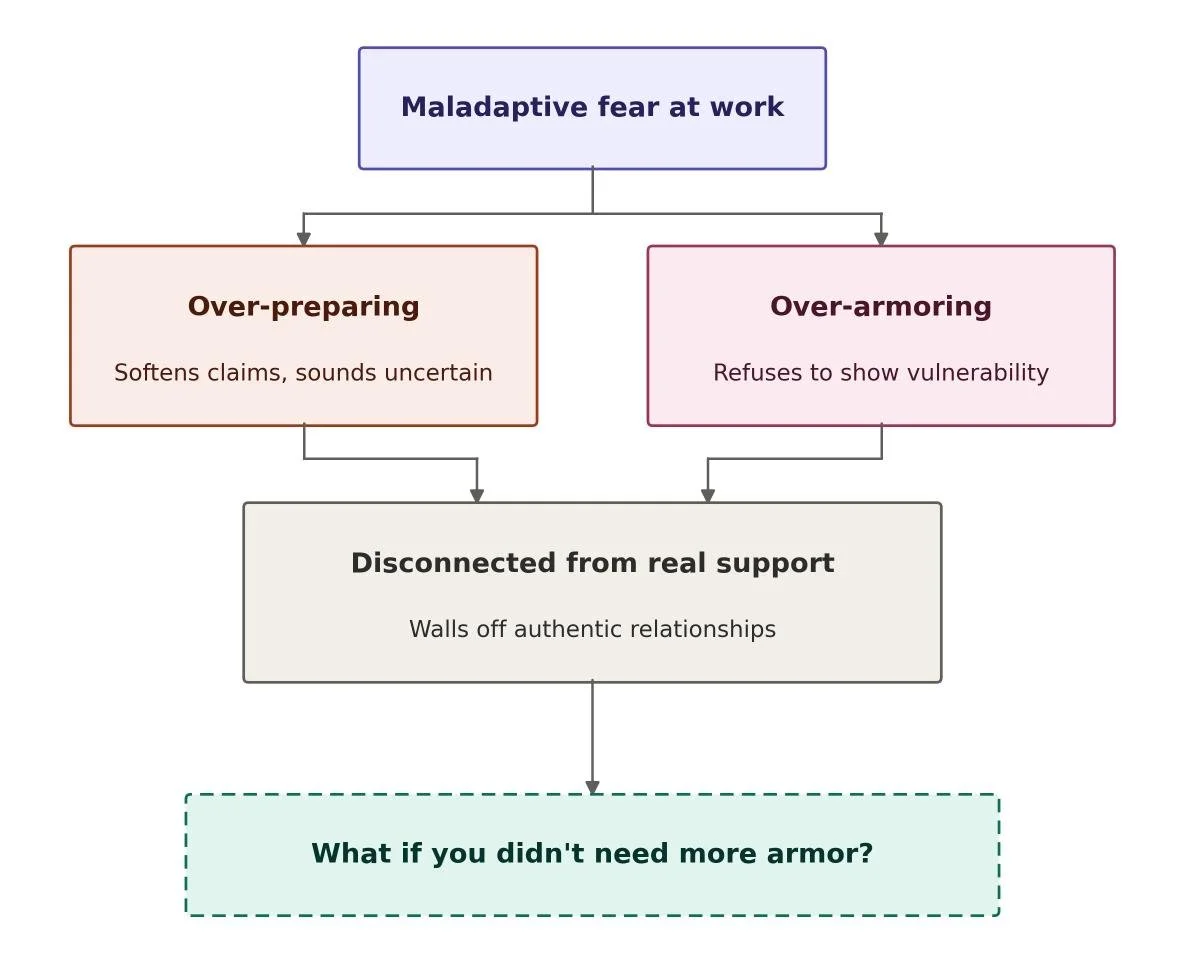
Over-preparing has a perfectionistic essence. You may over-qualify and soften your claims so you’re less likely to be questioned. But when you’re constantly trying not to step on anyone’s toes, you end up shrinking yourself. This runs the risk of being minimized, dismissed, and not taken seriously.
Over-armoring, on the other hand, has a compensatory “don’t fuck with me” undercurrent. You protect yourself from feeling weak by refusing to show vulnerability. It works in some ways, but it also carries long-term costs. Keeping people on their toes is very different from having people tiptoe around you. The latter may signal unchecked resentment.
Both responses are opposite sides of the same coin. They’re rooted in fear and can leave you disconnected from the authentic relationships that require vulnerability. You wall yourself off, and ultimately limit the support that could help you go further.
Calm Confidence
When you communicate in a room, you're communicating more than information. You're communicating and commanding trust.
You cannot do that from a dysregulated nervous system.
When you experience challenges as barriers, you may shrink into the weak-me inner child: overexplaining, hedging, or making sure no one else feels uncomfortable.
Notice when you're backtracking with phrases like:
"I know I might be wrong, but..."
"Does that make sense?"
Then ask yourself: How am I embodying this fear?
Are you shrinking? Pulling back? Over preparing?
Or are you armoring up with a I'm not going to give anyone a chance to fuck with me attitude?
Adaptive anger gives you another option. It helps you harness your energy and show up differently.
Say the statement. Then stay silent.
Let the silence speak for itself.
I always encourage clients to practice these skills in their professional domain first. That's where they feel most competent.
Then we turn to the more challenging terrain of their personal life.
Reclaiming Your Energy
A personal example might help ground these ideas.
I hate crowds. I get overstimulated and fatigued easily, and part of my healing has been learning to protect my energy the way an athlete protects their body.
So when my partner mentioned wanting to go to Costco on a weekend, my first thought was, absolutely not.
Choosing Honesty Over Self-Abandonment
He hadn’t asked me to come, but I felt the familiar impulse to volunteer myself anyway. Since I’ve been intentional about showing up more honestly in my relationships, I told him I wasn’t available.
The following day, I felt more energized and clear. After sitting with myself, a spontaneous compromise emerged. I realized I was willing to go as long as we went right when they opened. Otherwise, he could go without me.
Surrendering to Trust
I didn’t abandon my own experience to manage his. I noticed the urge to overextend and let it pass.
Later, during yoga, I felt tenderness toward him arise naturally. Because I had connected more deeply with myself, I found myself wanting to move toward him—not from obligation, but from desire.
✨ When we track our innate responses in this way, we begin to move from a place of internal trust and expansion. Our energy is constantly giving us feedback, we just have to be willing to listen. ✨
Clarity comes through action—action that helps us become conscious of the unmet needs beneath our reactions.
Transforming the Rescuer Reflex
From there, we can meet others as they are in the present, without unconsciously reparenting them or waiting for them to rescue us from our own emotional discomfort. Because there’s truly nothing less sexy than turning your relationship into a parent-child dynamic.
In doing so, we interrupt long-term patterns of self-abandonment through conscious responsibility and begin rewiring new pathways toward authentic connection.

Emotional Maturity
The embodiment of self-awareness and confidence requires enough inner work to know yourself well.
It means being able to self-soothe during an emotional storm and take responsibility for your response to circumstances you most often never asked for.
This is emotional maturity: knowing what is yours, what isn't, and having enough internal authority to tactfully respond.
Synchronicity
Life flows in circles and waves. Sometimes that's difficult to see when we're forced to surrender to what is outside our control.
There are moments when we're humbled beyond belief. Heartbroken and completely disoriented. Forever changed by circumstances we never would have chosen.
In her powerful book Sovereign Love, Dene Logan invites us to reframe the question:
Why is this happening to me?
to
What has this moment come to teach me?
The deeper phases of healing invite an attitude of surrender. A willingness to loosen our grip on what we cannot control and trust that something within us is capable of meeting what comes next.
Sometimes that means trusting something greater than ourselves. Sometimes it means trusting our own capacity to endure, adapt, and emerge changed.
And often, we come out the other side as a more honest, humbled, and refined version of ourselves. A version we couldn't have predicted from where we started.
Creating Sacred Space
If you have no idea what this might look like for you, create a ritual. Or return to one you've neglected.
A ritual is a symbolic act practiced with intention. My yoga mat symbolizes my sanctuary: a place where I get to come into my body. Every morning, when I roll out that rectangular piece of polyvinyl chloride, I’m making space for the “irrational”—the parts of me that don’t need to be explained, solved, or shaped to fit someone else’s expectations.

Through breathwork, respectful listening, and mindful movement, I create the conditions for something new to come through. An idea to become inspired by. An image from my dream. An unresolved emotion. An avoided sensation. Or the thwarted instinctual anger I can claw out like a tiger and roar like a lion.
Yoga mobilizes me to expand beyond the ways I’ve been conditioned to be smaller, quieter, more agreeable, and easier to accommodate.
Ritual gives us a way to stop overriding ourselves and start listening, placing us back into right relationship with the soul.
Carving out intentional time for ourselves also interrupts shadow rituals—vices, indulgences, obsessions, and compulsions that can become automatic ways of avoiding being present with ourselves.
Lead With Momentum
If you're someone accustomed to being capable, composed, and a bit of a perfectionist, integrative depth therapy offers the opportunity to help you move from a place of trust instead of fear.
I work with clients online throughout Washington, including Seattle and the surrounding areas, as well as in person at my Bellingham office for those local to the area.
You don't have to keep armoring up or overexplaining yourself to be taken seriously. If you're ready to reclaim your ferocity and lead from a more grounded, authentic place, reach out for more information about pricing and scheduling.
References
Dunlea, M. (2019). BodyDreaming in the treatment of developmental trauma: An embodied therapeutic approach. Routledge.
Greenberg, L. S. (2021). Changing emotion with emotion: A practitioner’s guide to the two-chair approach. American Psychological Association.
Logan, D. (2024). Sovereign Love: A Guide to Healing Relationships by Reclaiming the Masculine and Feminine Within. Sounds True.

Brianna Clement is a Licensed Mental Health Counselor and Certified Kripalu Yoga Instructor based in Bellingham and online throughout Washington. She integrates Somatic EMDR, Yoga-Based Therapy, and Ketamine Assisted Psychotherapy for holistic healing. Brianna’s approach is trauma-informed and depth oriented to help midlife professionals rebuild relational intimacy and discover their inner calling after traumatic loss. At Intra Psychotherapy & Embodiment, she is committed to integrating psychoanalytic wisdom with modern, research-backed methods to create meaningful change at the emotional core.
